Before you pitch your first brand you need four things: three sample videos in a portfolio folder, a portfolio link, a social account tagged for UGC, and a pitch you can send in under two minutes. Nothing else. Not a following, not gear, not a niche you have agonized over for two weeks. Finish those four and you are ready to send email number one.
Most people doing UGC for beginners get this backwards. They spend a month researching, watching videos, buying a ring light they do not need, and still have zero content to show a brand. A brand does not care about any of that. They care that you exist and that you can prove you can shoot. This article is the checklist that closes the gap between wanting deals and being ready to ask for them. I will give you the exact items, why each one matters, and the math on what happens after you start sending.
What UGC actually is, so the checklist makes sense
UGC stands for user-generated content. Regular people film videos of a product, the brand runs those videos as ads, you keep the product, and you get paid. You do not post it on your own page. The brand owns it and pays for it. That is the whole model.
The reason this works for someone with no audience is that the brand is not buying your reach. They are buying content that looks like a real person recommending something. UGC converts higher than polished influencer content because it looks like it came from a friend, not a studio. If you want the full breakdown of the term, I wrote a plain-English explanation of what UGC stands for separately. For this checklist, hold one fact: the brand wants proof you can shoot, not proof you are famous.
This changes what you need to prepare. You are not building an audience. You are building evidence. Everything on the checklist below exists to give a brand evidence in under thirty seconds.
Checklist item one: three sample videos
You need three videos before you pitch anyone. Not thirty. Three. Pick products you already own, sitting in your kitchen or bathroom right now, and film short ads for them as if the brand hired you.
The mistake here is waiting to be good. Your first videos will be bad. Film them anyway. A crappy portfolio that exists beats a perfect portfolio in your head every single time. Start ugly, ship it, improve on deal number two. Over-researching to get a polished approach before you shoot anything is the single most common way beginners stall out for six months.
Each sample should be 15 to 30 seconds, shot vertically on your phone. A hook in the first two seconds, the product in use, a reason to buy. That is it. You are proving you can hold a phone steady, talk to a camera, and make a product look worth having. Three of those and you have a portfolio.
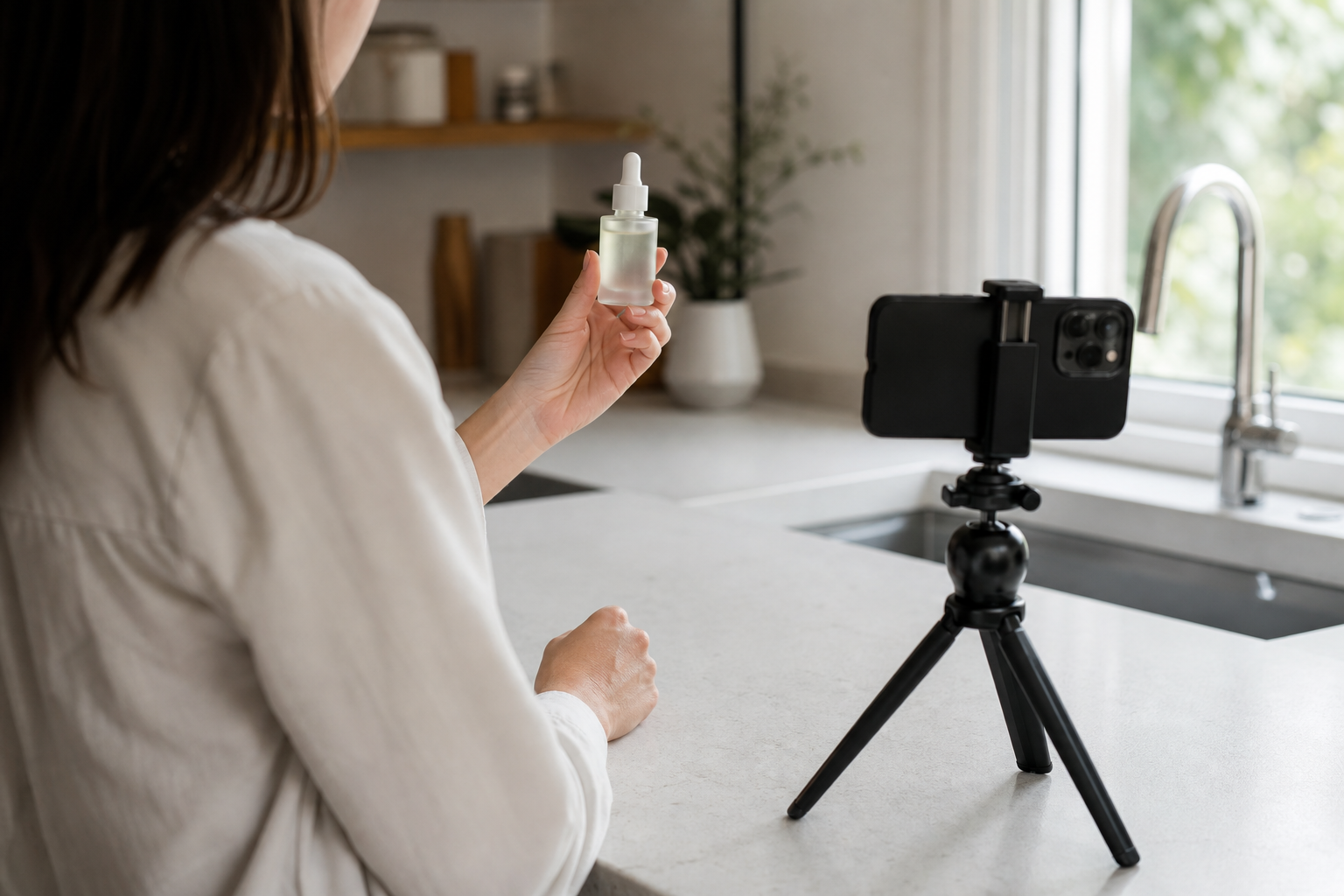
If the idea of what to say on camera is where you freeze, the difference between a flat video and one a brand pays double for is how you frame the product. I broke that down in a piece on story-selling versus storytelling. For your first three samples, keep it simple: show the problem, show the product solving it, say why it worked.
Checklist item two: a portfolio link
Put your three videos in a folder and get a shareable link. Google Drive works. A free portfolio site works. It does not matter which. What matters is that a brand can click one link and watch your work without asking you for anything.
The link is the only thing a brand actually looks at. They do not scroll your posts. They do not read your bio for insight. They click the portfolio link, watch ten seconds, and decide. That is why the link goes in your bio, in your pitch, everywhere. If a brand has to ask you where your samples are, you have already lost the deal to someone whose link was one tap away.
The minimum
A brand decides in under thirty seconds, so your job is to make those seconds effortless.
Three videos – enough to prove range without overbuilding;One link – shareable, in your bio, in every pitch;Fast reply – respond in hours, not days, and you outwork most creators
Checklist item three: a social account tagged for UGC
Brands search TikTok and Instagram for creators constantly. They type hashtags like UGC creator, UGC creators wanted, or a demographic tag like 40+ UGC, and they find people to hire. This is inbound, and it costs you nothing to set up.
You do not need followers for this. I started getting inbounds on my UGC Instagram with under 200 followers because brands do not care about your count. They care that you exist and that your account is clearly about UGC. Make a dedicated account, put your portfolio link in the bio, and post your sample videos there. Now you are findable.
The big, avoidable mistake I made was staying on one platform for a full year, waiting for orders like that was the only door. There is more than one way in. Platforms like Fiverr are one. A tagged social account pulling inbounds is another. Cold pitching is a third. Do more than one at a time. If you are starting on a specific platform, I have walkthroughs for building a UGC presence on TikTok and for doing it on Instagram without a following.
How to warm up the algorithm fast
Go search UGC creator, UGC creators wanted, UGC creators needed. Follow the creators posting under those tags. Engage with their content: like, comment, repost. Within a couple of days your feed only serves you UGC content, which tells the platform exactly what your account is about. That signal helps brands find you and helps you learn the format by watching what works.
Checklist item four: a pitch you can send in two minutes
Once the first three items exist, the whole game becomes volume. This is where the math matters. If you send 10 pitches and get 1 reply, and 1 in 5 replies closes, that is 50 pitches per deal. That number is not discouraging. It is a target. It tells you exactly how much activity a deal costs.
So your pitch has to be fast to send. A short, clean message: who you are, that you make UGC, one line on what you noticed about their product, and the portfolio link. Good grammar. No essay. If it takes you twenty minutes to write each pitch, you will never hit 50. If it takes two minutes, you send 50 in a week without breaking stride. I went deep on the numbers in the pitch math breakdown, and on the reasons pitches get ignored in why brands are not responding.
The two variables you control are volume and reply quality. Send more, and reply fast when someone bites. Use good grammar, respond quickly, and show them you are easy to work with. That behavior is what turns a one-off into repeat work. Reliability is what earns the retainer, and I mapped the full retainer system if you want to see where this leads.
What is not on the checklist
Expensive gear is not on the list. Your phone shoots fine. A follower count is not on the list. Brands do not buy reach from UGC creators; if they wanted reach they would hire an influencer, which costs them far more. A perfect niche is not on the list either. Pick products you already own and start.
Age is not a barrier. The older you are, the more in demand you are, because there are fewer creators in older brackets and brands need faces across every demographic. Anyone can do this. It takes consistency, not credentials.
One more thing people put on the list that does not belong there: worrying who will see your ads. If a friend seeing your UGC ad embarrasses you, you are going to struggle, because getting good means brands put ad spend behind you and your work goes wide. That is the goal, not the risk. For a fuller picture of starting cold, the guide on becoming a UGC creator from absolute zero and the one on landing your first paid deal with no experience both cover the ground around this checklist.
Free training
Learn the full UGC system from the checklist to your first paid deal.
Get the exact steps – portfolio, pitch, and the math behind closing;Start this week – build three samples and send your first pitches
Affiliate link: if you sign up through it I may earn a commission, at no cost to you.
Doing UGC for beginners the right order
The order matters more than any single item. Build the three samples first, because everything else points at them. Get the link second, because the samples are useless if a brand cannot see them. Set up the tagged account third, so inbound can find you while you pitch. Write the fast pitch fourth, and then run volume.
Most people doing UGC for beginners reverse this. They set up a beautiful account, agonize over a niche, buy gear, and pitch with nothing to show. Or worse, they research for a month and never film. Momentum is what carries you from one deal to the next, and momentum starts with a bad first video, not a perfect plan.
Finish the four items. Then measure. Log every pitch you send and every reply you get in a simple tracker. After 50 pitches you will know your real numbers, and your real numbers tell you what to fix: no replies means the pitch or the samples, replies but no close means the rate or the follow-up. That feedback loop is how this becomes a business instead of a hobby.
Frequently asked questions
How many videos do I need before pitching brands?
Three. Enough to prove you can hold a phone steady, hook a viewer, and make a product look worth buying. More than three delays you without adding much. Film samples of products you already own, get them into one portfolio link, and start pitching. You improve on real deals, not in your portfolio folder.
Do I need followers to start UGC?
No. Brands do not buy your reach from UGC, they buy content that converts. I got inbounds with under 200 followers because a tagged account and a portfolio link matter more than a count. If they wanted reach they would pay an influencer, which costs them far more than paying you.
How many pitches does it take to land one UGC deal?
Roughly 50, if 10 pitches produce 1 reply and 1 in 5 replies closes. Treat that as a target, not a warning. It tells you exactly how much activity a deal costs. Keep your pitch short enough to send in two minutes so 50 is a week of work, not a month.
What equipment do I need to start UGC as a beginner?
Your phone. That is the whole kit for your first deals. A basic tripod helps and natural light near a window is enough. Do not buy gear before you have shot anything. Spending on equipment is how beginners feel productive while avoiding the one thing that matters, which is filming.
Heads up: this article links to a free masterclass through an affiliate link. If you sign up through it I may earn a commission, at no cost to you. I only link things I actually use.